Website Ideas: Types of Websites You Can Create (and Make Money From)
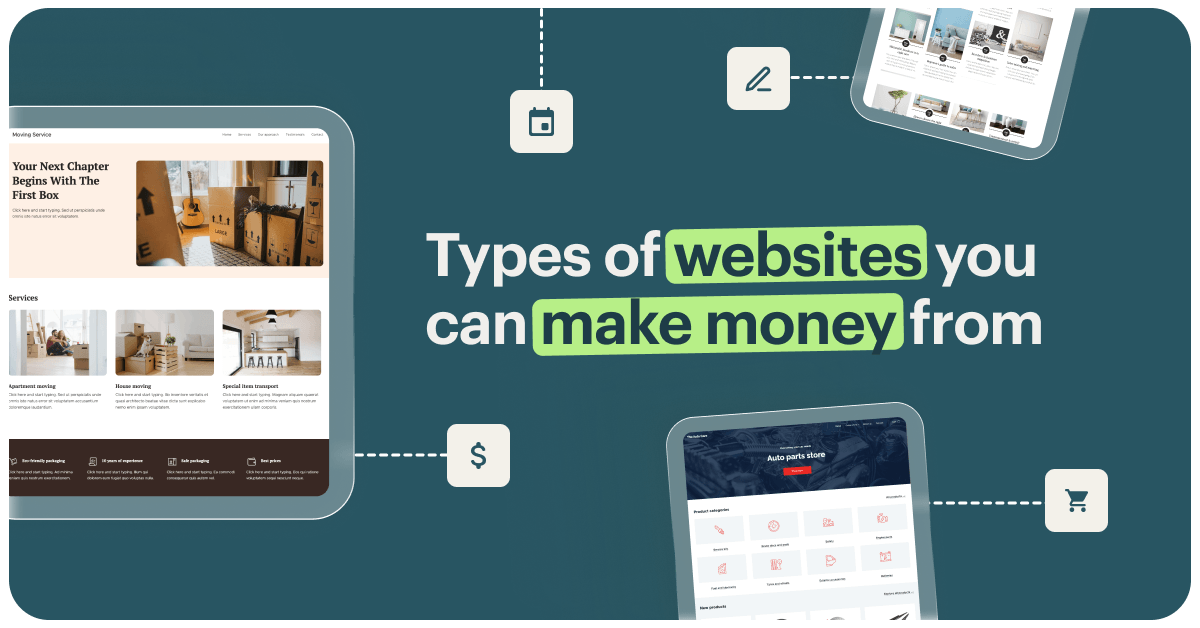
Website ideas come in a few main types (blog, online store, booking page, membership, landing page) and each earns money differently.
Almost everyone has something a website could be built around — a skill people already pay you for, a hobby you know inside out, a product, or a cause worth supporting. The hardest part isn't the tech; it's picking from the many website ideas out there the one that actually fits you.
This article walks through the website ideas a complete beginner can realistically build and make money from, what each one is for, and the part most guides skip: how each one actually earns. No code needed. A modern website builder handles the technical side, so your only real decision is which type of site fits your idea.
CONTENTS:
- Purposes of website types
- How to choose the right website type for you
- Money-making website types
- How much can each website idea realistically earn
- How to create your website and start earning with Webnode
- FAQ
Purposes of Website Types
Before we get into the money side, it helps to see the whole map. The different types of websites out there almost all exist for one of four reasons. Find yours in the table below.
Purpose | Examples of websites that fit |
Entertainment | Community websites, magazine and news websites, wedding websites. |
Making money | Business websites, online stores, affiliate and niche sites, blogs, membership sites, booking sites, landing pages, donation sites, event websites. |
Educating | School websites, knowledge bases and help centers. |
Self-realization | Personal websites, portfolios, hobby websites. |
Plenty of sites do two of these at once. A hobby blog that starts earning, for example. But knowing your main purpose tells you what to build first.
How to Choose the Right Website Idea to Make Money
You do not have to read the whole list below and hope something jumps out. Three questions narrow it down quickly.
First, what do you already have? This is the one that decides it most of the time. A skill people book becomes a service site. A product becomes a store. Deep knowledge of one subject becomes a blog or a niche site. A cause becomes a donation site. One single offer becomes a landing page. Start from what exists, not from what sounds most profitable.
Second, how soon do you need money from it? Some types can earn from a handful of visitors. Others need an audience first, and audiences take months to build. Neither is better, but the gap between them is where most people get discouraged.
Third, how much time can you give it each week? Honestly, not hopefully. Two hours a week rules out anything that depends on publishing constantly, and that is useful to know before you start rather than after.
If you are wondering how to make money from a website as a beginner, the answer is usually the least exciting option on the list. The best types of websites to start with no experience are the ones with the fewest moving parts: one page, one offer, or one skill you already sell offline.
👉 If you already know which one is yours, you can start building your website for free and come back to the rest of this later.
Best Money-Making Website Types
The rest of this article zooms into the second row of that table: the website types built to earn. Each one below covers what it is, who it suits, and how the money actually arrives.
Business Website
The most common type of all. A small business website presents what you do, who you are, and how to reach you. A few pages are often enough: what you offer, some proof that you are good at it, and a contact page.
It rarely earns money on the page itself. What it does is make people trust you enough to get in touch, which is why a butcher, a plumber, or a hairdresser should all have one. Most of the types below are really a business website with one extra thing bolted on: a checkout, a calendar, or a locked page.
👉 And if you'd rather not start from a blank page, Webnode's business website builder and its professional templates give you this exact layout ready to fill in.
Blog Website
A blog is a website you add articles to regularly, about one subject you know or care about. Baking, budgeting, hiking with dogs. The subject matters less than the fact that you can keep writing about it.
Blogs earn in three main ways. Display ads, through a network like Google AdSense, pay you a small amount every time someone loads a page, so income follows visitor numbers. Affiliate links pay you a commission when a reader buys something you recommended. Sponsored posts are when a brand pays you directly to write about them, which usually only starts once you have a real audience.
To start a blog, you do not need credentials. You need a subject you can write about twenty times without getting bored, and the patience to keep going while nobody is reading. Be honest with yourself about that second part. It is where most blogs stop.
👉 Webnode has ready-made blog templates, so you can skip the setup and go straight to writing.
Ecommerce (Online Store) Website
An online store is different from every other site here in one way: it is the only type built around a repeat transaction: a catalogue, a cart, and a checkout that runs every day rather than around one event or one appeal. Someone adds an item to a cart, pays, and you send it.
Before you open an online store, you need three things. Something to sell, whether that is physical products or digital ones like templates and courses. A way to take payment. And a plan for delivery, which means postage and packaging for physical goods, or an automatic download for digital ones.
Income here is simple math: visitors, multiplied by how many of them buy, multiplied by your profit per item. Digital products change that maths in your favour, because selling the hundredth copy costs you nothing.
👉 Have a look at Webnode's online store templates to picture your shop before you commit to building it.
Membership Website
A membership site puts some of your content behind a door and charges people for the key. Recipes, workout plans, lessons, industry analysis: anything worth paying for that you can keep producing.
The appeal is recurring income. A member who pays monthly pays again next month, without you finding a new customer. That is far steadier than one-off sales.
Here is how it works in practice. Most beginner-friendly builders, Webnode included, let you lock individual pages with a password you share with your members, rather than running a full automated membership system with sign-ups and subscription billing. For a small group, that is all you need, and it takes minutes to set up. Once you reach hundreds of members who all need billing on the same day each month, a dedicated system starts to make sense. Begin with the simple version and find out whether people will pay before you build anything more complicated.
👉 Learn how to create a membership website in a few easy steps.
Booking and Service Website
If you already do something people pay for, such as coaching, therapy, tutoring, dog grooming or plumbing, this is probably your website type. It exists to turn a stranger into a booking.
A booking-enabled website shows your availability and lets someone reserve a slot themselves, at eleven at night, without a single phone call. Restaurants use the same idea for tables, and guesthouses use it for rooms.
This is the shortest path from website to money on this whole list. You are not building an audience or waiting on ad revenue. One visitor books, and you have earned.
👉 Build a booking website on Webnode where your clients can easily reserve their own slots.
Affiliate and Niche Review Website
An affiliate site looks like a blog but has a narrower job. Instead of writing about a broad subject, it helps people choose between specific products in one small corner of the world.
That corner is the "niche". Not "fitness", because that is a category, and you will be competing with everyone. "Home gym equipment for small apartments" is a niche. Small enough that you can cover it properly.
The money comes from affiliate marketing. You link to a product, a reader buys through your link, and the retailer pays you a percentage. You never touch stock or handle a customer, which is why this is the type people have in mind when they talk about passive income, even though the work is simply front-loaded rather than absent. The catch is that commission-based income only starts once people can find you, so search engine optimization (SEO) matters more here than on almost any other site type.
Event Website
A wedding, a conference, a village festival, a workshop series. Anything with a date attached benefits from its own site. It holds the schedule, the location, the speakers, and the sign-up.
An event website earns through ticket sales, and often through sponsors who pay to have their logo in front of your attendees. Choose this over a general business website when the event is the point, when there is a date, and after that date the site is finished.
👉 Start from a Webnode event website template with the schedule, location, and sign-up already laid out.
Landing Page (One Page Website)
A landing page is a single page built around a single thing. No menu, no About section, no blog. One offer, one button, top to bottom.
It suits a product launch, a freelancer selling one specific service, or a sign-up form for an event. It works because there is nowhere else to click. A visitor either takes the action or leaves, and for a single offer, that focus is exactly the point of a landing page.
👉 Testing an idea? Build it on a landing page template and put it in front of people fast.
Nonprofit and Donation Website
A cause-based site does not sell. It asks. Animal rescue, a community project, a school fundraiser: the site explains the mission and gives people a way to give.
Income arrives as donations and sponsorships rather than sales, and it depends almost entirely on trust. Three things earn that trust. A mission stated plainly enough that a stranger understands it in ten seconds. A donation method that works in two clicks. And open reporting on where the money went. That last one is what turns a one-off donor into a regular one.
👉 A nonprofit website template gives you the mission-and-donate layout ready to go; you just need to add your cause.
How Much Can Each Website Idea Realistically Earn
All of these have ways to monetize your website, but they do not pay the same, and they do not pay at the same speed. Here is a grounded comparison of the profitable website ideas covered above.
Two figures are worth knowing before you read it. The Blogging Income Survey run by Productive Blogging found it takes bloggers an average of 21 months to start making any money from a blog, and just over 4 years to reach a full-time income — though 26% earn something within the first 6 months, and 24% reach a full-time income within 2 years.
The takeaway isn't that blogs don't pay. It's that they pay slowly, on a curve, while a booking page or a store can earn much sooner. That difference in speed is the real trade-off in the table below.
Website type | Typical startup cost | Time to first income | Typical income range |
Business website | Low. A plan, a domain, your details. | Indirect. It shortens sales you were already going to make | Hard to separate from the business itself. |
Blog | Low. A plan, a domain, and your time. | Slow. Survey data points to well over a year on average. | Nothing at first. A few hundred a month is a realistic early ceiling. |
Online store | Highest of the group. Stock, packaging, photos. | Fastest of the group, if people want the product. | Scales with traffic and profit margin. Volatile month to month. |
Membership site | Low. Your time goes into the content library. | Medium. You need an audience first. | Predictable once it works, because members pay every month. |
Booking/service site | Low. You already have the skill. | Fast. One booking is income. | Tied to your hourly rate and your free hours. |
Affiliate/niche site | Low. Mostly research and writing time. | Slow. A similar curve to a blog. | Commission-based. A few sales a month early on. |
Event website | Low. The event itself costs more than the site. | Quick, once tickets go on sale. | Depends entirely on ticket price and attendance. |
Landing page | Lowest. One page, one offer. | Fast. It exists to convert. | Whatever the single offer behind it earns. |
Donation / nonprofit site | Low. | Medium. Trust has to come first. | Not profit. It funds the cause. |
Comparison table of website types by startup cost, time to income, and earning potential.
Selling online is the one type where the direction of travel is officially measured. The U.S. Census Bureau put online sales at 17.1% of total US retail in the second quarter of 2026 — $340.2 billion, seasonally adjusted — growing 12.2% year on year while retail as a whole grew 6.7%. Online selling is still taking share. That does not promise your shop will work, but it does mean you are not building into a shrinking market.
So what type of website makes the most money? On paper, an online store, because it has no ceiling. In practice, the most profitable websites to start are the ones the owner sticks with, and that is a different question. The figures above are ranges drawn from published surveys and official statistics, not predictions. Individual results vary enormously, and the difference between someone earning nothing and someone earning a living is rarely the website type. It is whether anyone can find the site, and whether the person kept going past the quiet first year.
If you want a neutral, non-commercial checklist for the money side before you commit, the U.S. Small Business Administration publishes a free startup cost calculator and guide that applies to online businesses too.
How to Create Your Website and Start Earning with Webnode
You have picked a direction. Here is the honest version of what happens next.
You choose a template, replace the placeholder text with your own, and publish. That is genuinely the shape of it. Design, hosting, the mobile version, and security are already handled. Webnode has website templates built around each type covered here: an e-shop with a working checkout, a blog layout, a booking system for appointments, page locking for members-only content, and one-page designs for landing pages.

Webnode free website templates
The best website builder for beginners is simply the one that lets you find out whether you enjoy this before it asks you for anything.
Intuitive, Creative and Easy to Manage! I knew I wanted to do a travel blog but wasn't sure where to start. I found Webnode in a Google search. Setting up my webpage and publishing it for my friends and family to follow along with my travels was easy. Overall, Webnode has been intuitive, creative, easy to manage, and has a team full of support and concern. I am grateful to have used it for my first ever travel blog.
Elisa Yaeger - travelinggringa.webnode.page
You do not need to decide everything today. Pick a template and start free with what you already have, whether that is a skill, a product, or a subject you know, and build the small version of it. You can add a shop to a blog later. You cannot add momentum to a site you never started.
Ready to get your website online?
Start building with Webnode and see how easy it can be — you can have a first version up in as little as a day.
Frequently Asked Questions
The one that matches what you already have. A skill people book turns into a service site. A product, physical or digital, turns into a store. Knowledge plus the patience to keep publishing turns into a blog or a niche site. There is no single best type, only the one you will still be working on in six months.
You can start for free. Webnode's free plan lets you build and publish with no time limit, in exchange for a Webnode web address and a cap on features. Paid plans add your own domain and remove the branding for a few dollars a month. After that, it comes down to your idea rather than the website: a blog or a booking page needs little more than your time, while an online store also means paying for whatever it is you sell.
The easiest website to create and make money from is a landing page or a booking site. Both are small, both have one clear job, and both can earn without an audience. A booking site in particular skips the hardest part of online income, because you are selling something you already do, to people who already need it.
It depends on whether the type needs an audience first. A booking site or a landing page does not, because a single interested visitor can lead to a sale, so income can arrive early. Blogs and affiliate sites work the other way round: people have to find them through search before anything else can happen, and that side of it is usually measured in months of steady publishing rather than weeks. The timing comes down to your market, your prices, and how consistently you keep at it.
Start building your website today with Webnode

Csilla Huszárik has 8 years of content writing experience, combining her passion for storytelling with a tech background. She specializes in translating complex technical concepts into user-friendly, benefit-oriented content that delivers value while converting well. Having lived in multiple countries, she speaks and writes in four languages and loves exploring new destinations.